Ownership crossroads

image

It’s been a long time since the last update on my F355. After 9+ months of being with Ferrari, I was finally informed it was good to go.

I went down went down to Ferrari and picked that car up. As it had little fuel in it I stopped at a petrol station to put some juice in the tank. As soon as I got back in car, the “chugging” returned. I therefore limped the car back to Ferrari and it is once again with them.

Now’s here’s the question, what do I do? I can’t sell it while it’s broken and no one seems to be able solve the issues.

Finally a COG I’m happy with

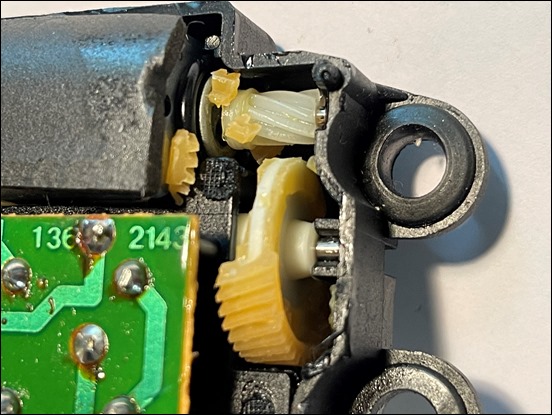
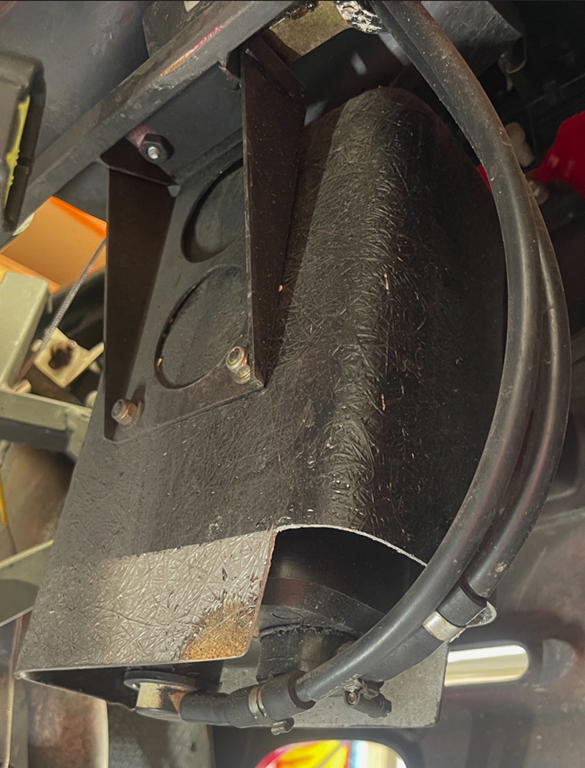
If you have been following with my efforts to create a cog to replace this:

clip_image001

Which stemmed from:

Gear of misfortune

which was basically that the cog from the 63307100 Timing Actuator had been stripped, will know that I have made quite a few attempts with crafting a replacement part myself.

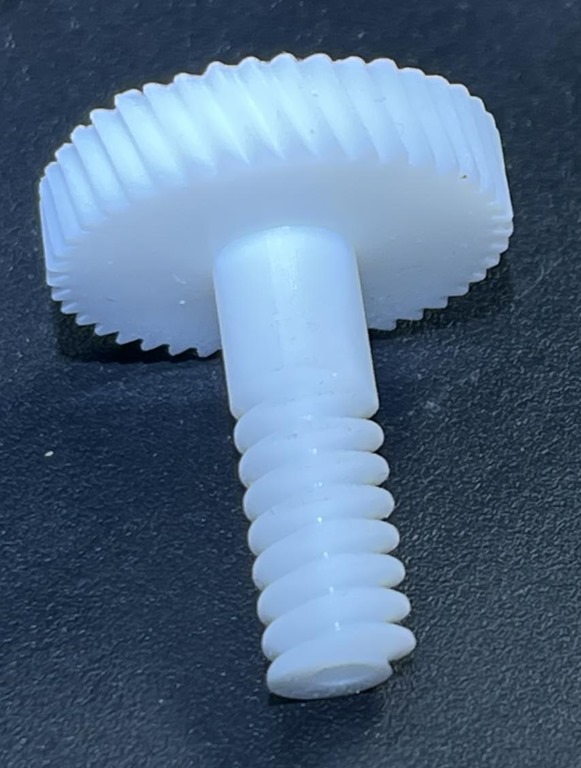
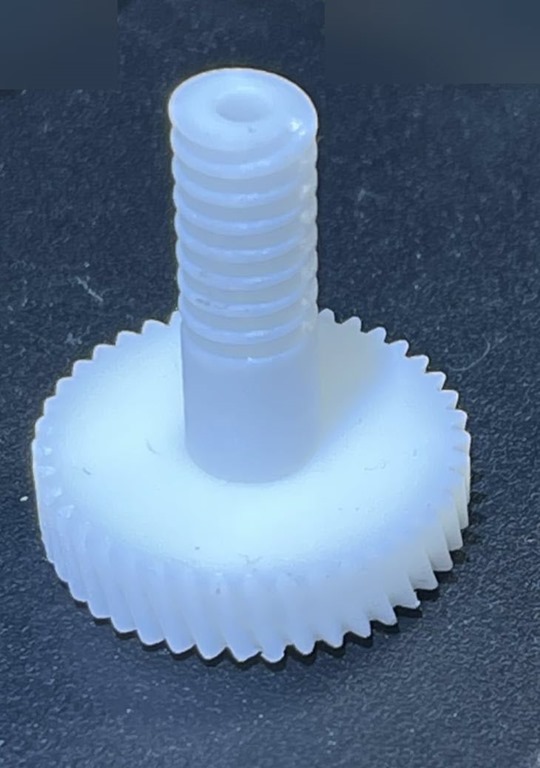
In the end I decided that it would much better if I got some real professionals to do this for me and I’m happy to say that is now done.

cog-1


cog-2

I am very happy with the result and have tested in the Timing Actuator and it works well.

I’m now going to order a batch for resale so if you are interested in one please reach out via the comments to this post and watch out on the blog site where I’ll put up more details soon.

It’s been a long and challenging road with this simple cog but it seems that I’m finally at the destination and can now move forward with the next challenge I have in mind for creating a replacement part.

A trial separation

After my all frustrations with the car back in February I decided to take the car to Ferrari as a last resort to see if they could turn up any issues to solve my mystery stuttering. The long and short of it is that the car has remained there since then (February) and is still undergoing repair, typically awaiting parts.

They have needed to start from first principles and run through a series of standard tests such as:

1.    Battery health check
2.    Charging system check
3.    Fuel pressure check
4.    Compression check
5.    Spark check
6.    Timing check
7.    Gas analysation (this would also confirm catalyser incongruence)
8.    oscilloscope on major sensors
9.    Heat scanning
10.    Testing

The major points that this first pass found where:

1.    Rectifying the air leaks at the intake manifold and then re-testing for any further leaks. The Motronic is trying to compensate for this (can be seen by the increased multiplicative fuel trim) and may well be inducing further problems. With the manifold raised it would be advisable to check the synchronisation between the throttle butterflies.


2.    Further investigation of the fuel pressure loss occurring after engine shut down. Preliminary testing ruled out a leak through the pressure regulator vacuum lines. The most likely cause would be leaking injectors flooding the cylinders. This would explain why it is hard to start the engine when hot if left for a 30-60 minute period but starts easily if restarted straight away when or if left for an extended period allowing the fuel to evaporate.
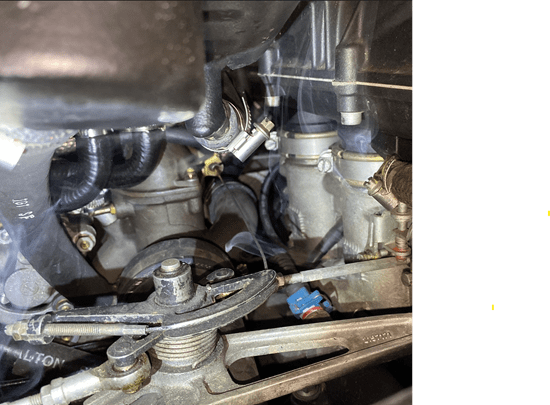

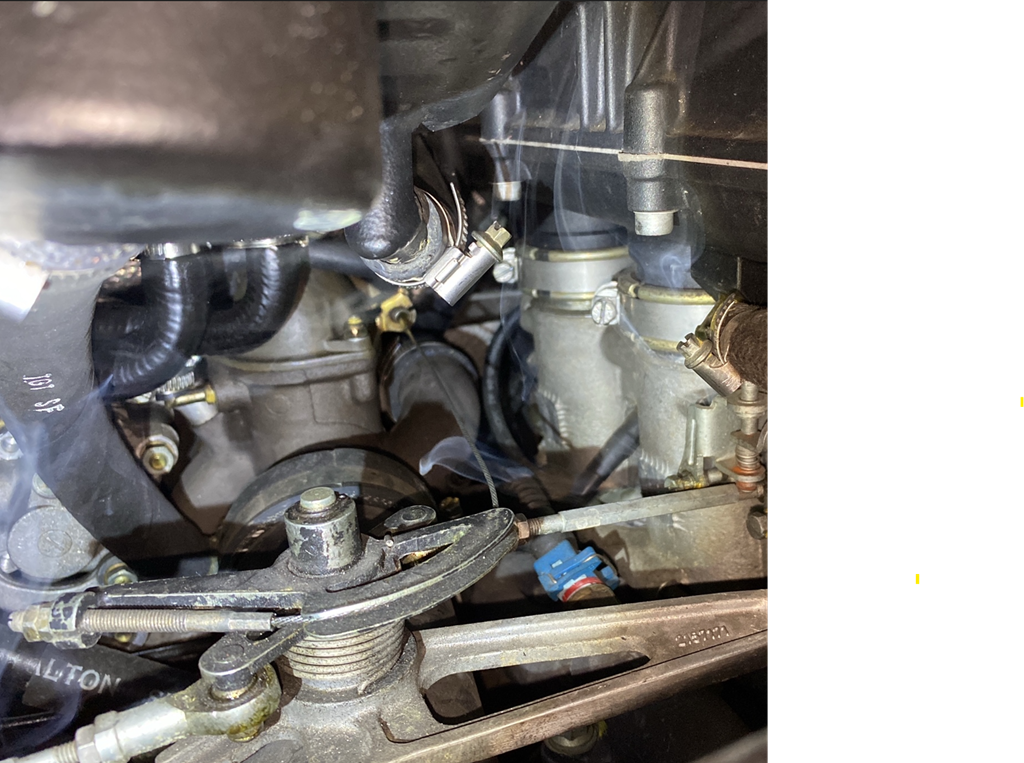
sshot

Above you can seem some of the results they sent me using a smoke test. This highlighted the air leaks at the intake manifold.

During this time I managed to make contact with Phil Hughes from Ferrari Fixer in Melbourne, who was recommended by another contact. He said:

that they have made no mention of the dual mass flywheel.


When the DM flywheels lose their internal grease damper through natural degrading over time, they then crank with an erratic noisy/dirty electrical signal on the two crank sensors and the cam sensor. When the flywheels are on the verge of this, they can be ok when cold as the remaining grease is sticky and firm, but when hot the grease goes runny, losing damping effect.


I would suggest the car needs a deeper look into the implausible coolant temp readings, but more likely a flywheel service.


There is also the option to delete/lock the DM flywheel and remove the issue permanently. This does cause a slightly less smooth idle than when the flywheel works properly but more often than not the faulty DM flywheel makes the idle more rough than as if it were locked, as it appears in this case as noted in the dealer report.

I had Ferrari check this flywheel grease and they found it was about half the level that it should be, so they sent away for the right grease to repack it. So probably not necessarily the main issue but worth fixing while the car is in the shop as well as eliminating any issues there.

Ferrari then did a check of the injectors and found that some where dripping when closed:
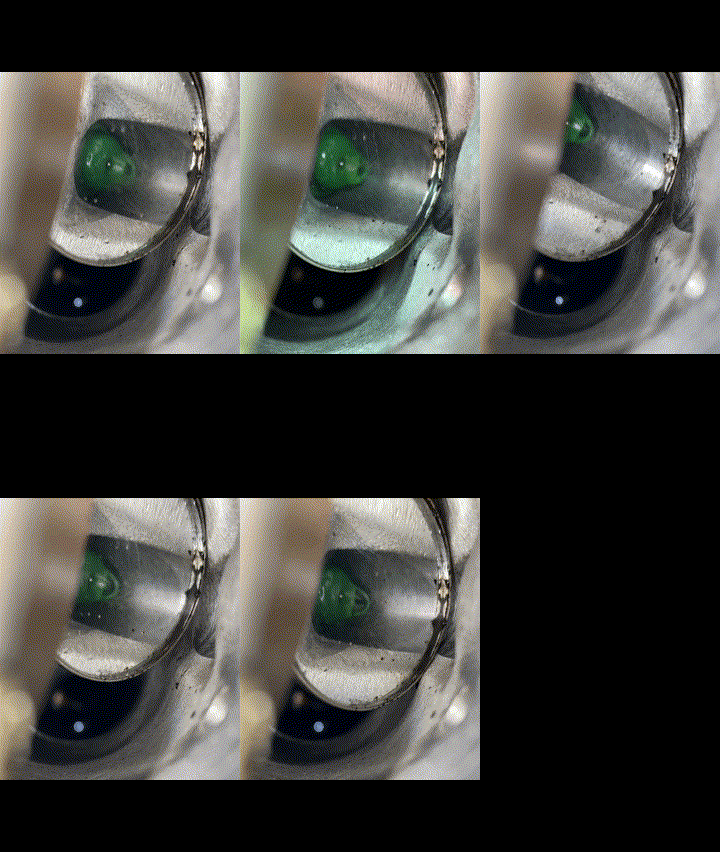
injector

With that identified, it is off to the parts bin to find replacements for these.

Apart from all that I also need my centre console fixed as well as get my tow hook properly aligned. Turns out that if I had ever needed to use my tow hook it would not have fitted as designed into the front of the car. Part of the body work is just far enough across the hole to prevent the tow hook from aligning and screwing in correctly. It would be doubly painful to have an issue with the car out somewhere far from home and then not be able to use the tow hook to get it onto a flat bed if needed.

Thus, the car has been away now for over three months under going thorough testing and the following items have been identified and are being rectified as we speak:

1. Intake manifold seals (awaiting parts)

2. Repack mass flywheel (awaiting correct grease)

3. Injectors (awaiting parts)

4. Console trim housing

5. Tow hook alignment

It has been disappointing not to have the car but I really don’t want to deal with it if it keeps failing and being as unreliable as it has been. Thus, it is better that it stay away until it is fixed. If I do decide to sell it after all this then it still needs to be fixed as much as possible before then, so all I can do is wait for this repair to complete and then see what happens. I certainly hope that all this resolves the stuttering issues and I’m sure the car will run a lot better when I get it back.

Fingers crossed.

Yes, but what type of screw?

image

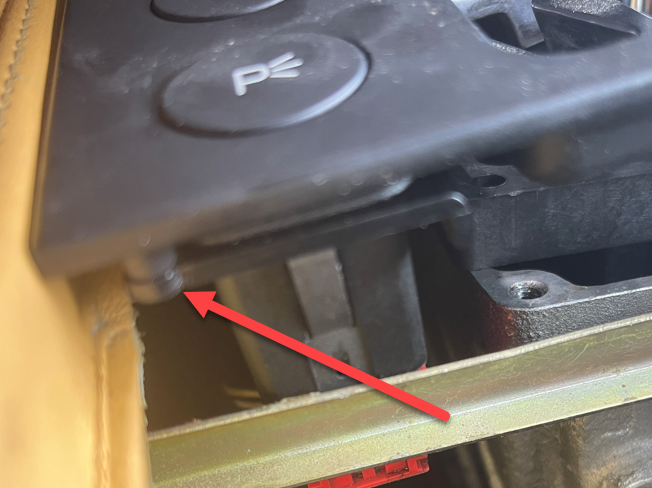
Yet another problem that surfaced recently was the buttons in the centre console being pushed through because the screws that hold them to the frame have come loose. I pulled the console apart and was able to identify the location of one of the missing screws as shown above.

I’ve managed to track down that the part number of the screw in question is 15900270 but it is simply identified as a ‘Screw’, which is not very helpful to me. I need to know two major dimensions, the length and the gauge. If I get a screw that is too long I’ll pierce the face of the frame with the tip. If I get one with the wrong gauge (width) then I’ll ruin the housing it screws into.

So, I’m going to have to take punt that one of these three does the trick:

4G x 6.5mm

6G x 6.5mm

8G x 6.5 mm

Turns out that the width of a screw is known as the gauge and the conversion table from imperial (gauge) to mm looks like:

image

Thus, what I’ll try (all in mm is)

2.9mm (w) x 6.5mm (l)

3.5mm (w) x 6.5mm (l)

4.2mm (w) x 6.5mm (l)

I did my best to measure the housing that the screw will go into and i got:

4.7mm (w) x 9mm (l)

so my best guess, at least initially will be the

3.5mm (w) x 6.5mm (l)

but I’ve had to order 100 of all three types just so I have them on hand. Annoying that I need just one screw and have to buy 300 to try and find that one right screw. Livin’ the dream.

Hopefully, the ordered replacement screws arrive soon and I can try and fix the button mount and get the console back together. Then, I can decide what to ultimately do with the car.

This may be the end

image

It is with regret that I report that my ownership of a Ferrari F355 maybe at an end. The ‘low power’ issue continues to plague that car and the ownership experience is no longer enjoyable.

After the recent major engine out service, where the charcoal cannister was also replaced, problems started again to surface a few weeks afterwards. The car became harder to start and when it did the revs would start low and them increase. Later on the revs wouldn’t increase and the car would remain in ‘low power’ mode. There are no warning lights on the dash, just a car which struggles to get up any incline.

This all came to head over the last weekend when I headed to Bathurst for the 12 hour race. I knew there was a risk that things would fail, but given the intermittent nature of the problem I felt I needed to force the issue to see the result. Unfortunately, just after I got the car over the mountain range and into Lithgow it struggled to actually start and again had no power.

I let it cool, removed the fuel cap, reset the battery and did everything I could think of, but again now power. I therefore decided to abandon the trip to Bathurst and try and limp the car home. This meant I had to limp the car up a 1 in 8 gradient back up the mountain via Victoria pass! Painful to say the least.

Of course, half way home, the car resumed normal mode and ran like a dream. To top things off, the button on the centre console have dropped through as the screws holding them have also come loose and now the buttons hang loose inside the console near the gear stick.

In short, this ‘low power’ issue has continued now for over two years and there is no solution in sight. I am hesitant to keep throwing money at something that has no path to a reliable solution. It seems to come to randomly changing parts.

I appreciate that intermittent issues can be hard to find and resolve, especially if you can replicate issue on demand. I get it, but I don’t think I can keep going through the discomfort of taking the car out and wondering whether it will fall back into ‘low power’ mode and I’ll have to stress and get it back.

Maybe this the end of my relationship the F355?

Radiator Fan fuses

After recently having an issue with a blown radiator fuse in my F355 I thought it would be a good idea to car some spares with me. I also wanted to review where the fuse box was located. I did some searching but didn’t find anything straight forward. So here it is.

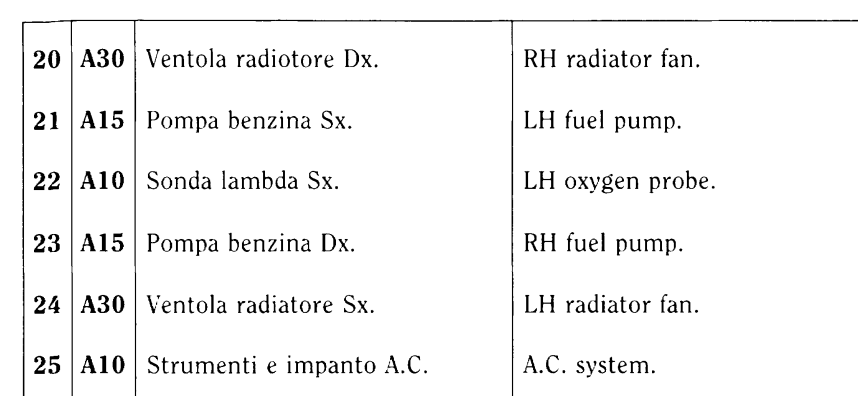
In Section L – Electrical System page L21 of the owner’s manual you will find a diagram of the fuse box layout:

If you look at the legend you’ll see:

that:

20 = RH radiator fan

24 = LH radiator fan

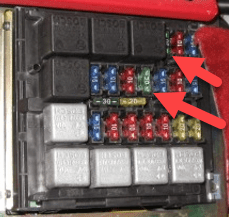
Thus, they are here:


The fuse box location is in the front of the foot well on the passenger side, which you access from inside the car. An old photo I have is:

which looks a bit strange compared the owner’s manual but that could be because my car is Australian delivered. If you look carefully you can line up the layout (in my picture there are 3 x relays at the top, while the owner’s manual has the same 3 at the bottom).

You can also pick the radiator fuses because they are larger (initially 30A but now 40A) that any others. I’ll have to get a better picture at some stage.

So if your F355 is getting overly hot when stuck in traffic for example, first step is to peel back the front all of the passengers foot well and check that the radiator fuses are not blown. They were originally 30A but have been upgraded to 40A as the ‘unofficial’ fix I was told. Main point, is I now carry some spares, just in case and now I also know where they are if they need to be replaced!

Sprung

image

image

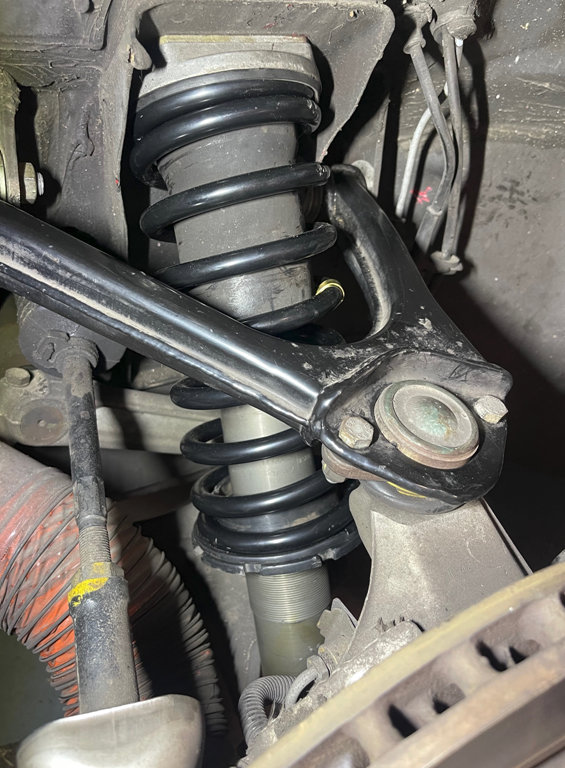
As you can see the new springs are now in place on the car.

Here’s the difference between the old and new springs from the front of the car.

image

The older spring is on the left in the above picture.

I can also attest to the fact that ride is much better. The car doesn’t ‘crash’ into bumps anymore, it takes them in its stride. However, it does now appear that the suspension warning light likes to come on regularly. Let’s see what time bring on that one.

I’m looking forward to taking the car out for a spin on the weekend through a few ‘twisties’ to see what the handling is like. The ride height has also been raised a bit, hopefully to overcome it smacking it’s nose.

image 

I am also pleased to say that the heat shield over the exhaust was also cosmetically repaired as seen above. It was always an annoying eye sore when I looked at the engine. Now, no more! Yeah.

Also, one of my cooling fans had a blown fuse, which sort of explained why the car almost overheated in traffic on the way to get serviced. The fix is just to install upgraded fuses. Glad, that was checked and resolved. Would not have been nice to overheat in traffic again thanks to a blown fuse.

There still remain some outstanding items to address:

– the A/C mixing flap still doesn’t work, even though I sourced a replacement COG for it. Possibly a main controller unit issue but we’ll need a spare one of those to test before we can be sure.

– the suspension warning light seems to want to come on during start up and at random on a drive. Let’s give that one some time and see if there is pattern to why it’s doing that.

– even though the EVAP system has been thoroughly checked and a new charcoal cannister installed the car still smells a little ‘fuely’ after a drive. It has always been like that but I would have thought that a new charcoal cannister would have rectified that issue. I’ll need to do some more research to see what is normal when it comes to fuel smells after a drive.

– after the interior refurbished I can feel an airflow just below the handle of the drivers door. Seems to be coming from outside the car. Not a huge issue and I’ll need to have a closer look when a get a chance.

– as mentioned before the valve guides are going to need doing. The aim will be to take car of that around mid year.

However, all the belts and fluids have been done as well as the hydraulic tensioners, spark plugs, etc. as part of the engine out service. The ride feels much better now, so I just need to wait for the weekend to see what the handling is truly like.

The engine is out

image

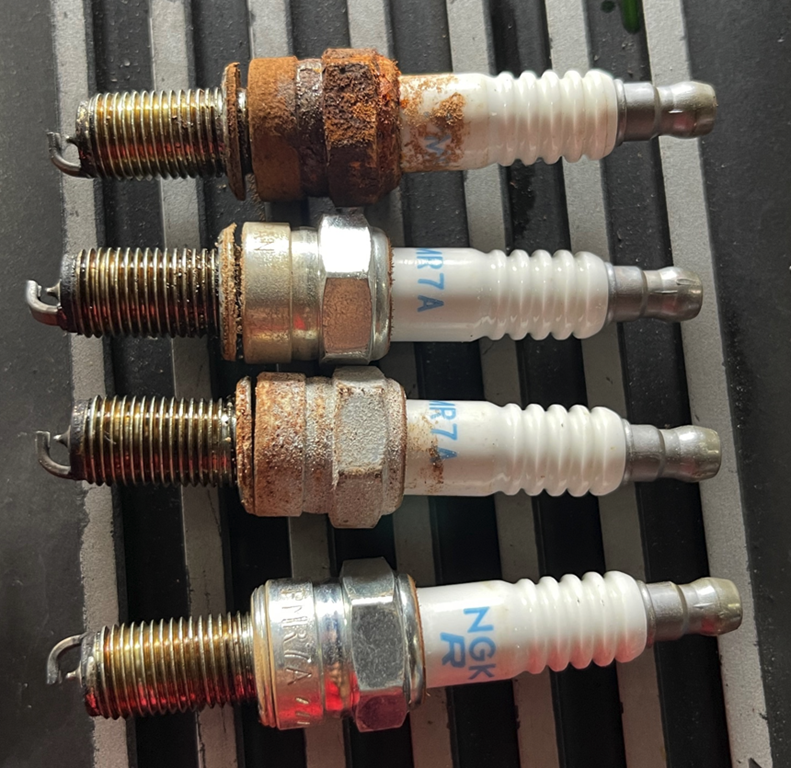
The F355 is in for it’s annual service and this one will require an engine out and belt change amongst many other things. As you can see above, indeed the engine is now out.

image

Interestingly, there is some major corrosion present on the outside parts of the plugs as you can see above for cylinders 1 – 4

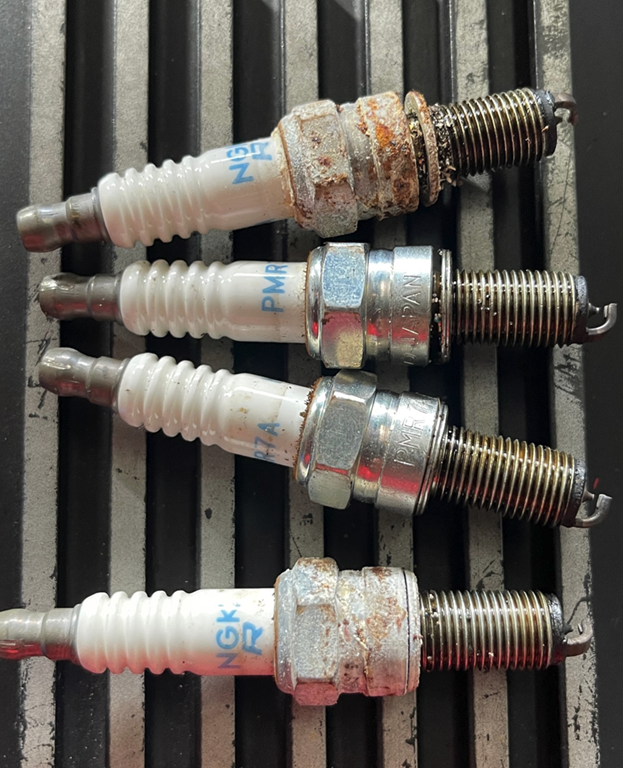
image

and cylinders 5 – 8, above. This is strange given that the corrosion is on the part of the plugs that is outside the cylinder! It is also interesting that two plugs on either side are largely unaffected while two others are quite corroded. The part that goes inside the cylinder is fine. This kind of suggests that somehow water has been trapped in and around the plugs for some reason.

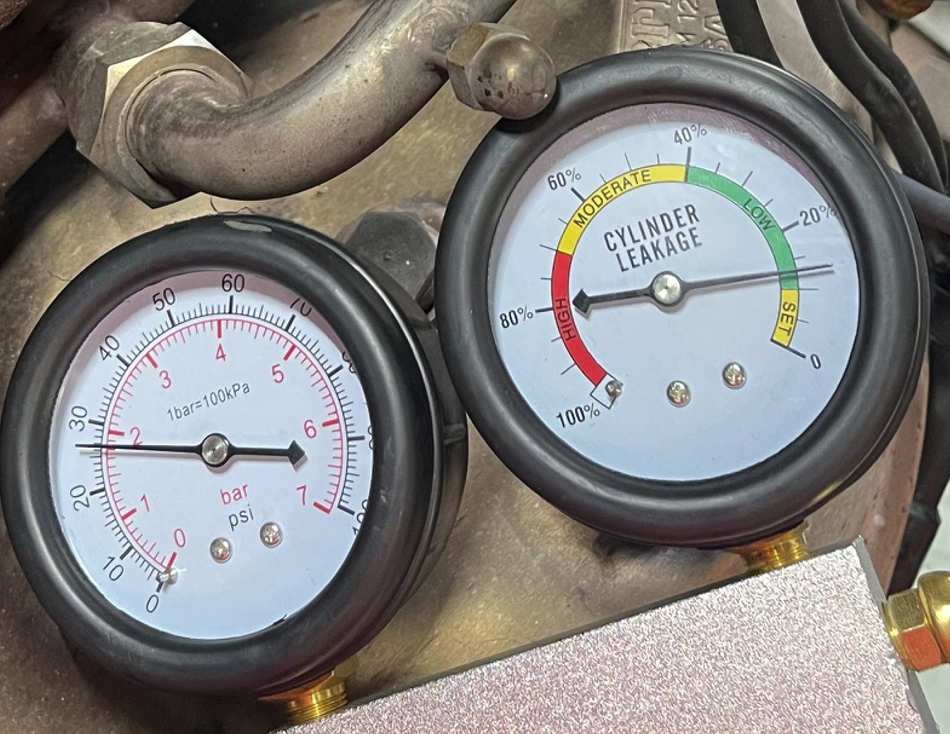
Next was a leak down test on all the cylinders.

image

Most of cylinder are good, like above, except:

image

Cylinder 4 at 30% and

image

and Cylinder 3 also at 30%.

This is a loss of power in those cylinders and is typically caused by wear on the valve guides. Getting that fixed is a major job for the future but it good to have these readings as a benchmark.

image

No signs of issues with the evap system but got a replacement charcoal cannister just in case.

Still more work to be done but the corrosion on the spark plugs is a bit of a mystery and the valve guides will need replacing down the track as well.

Let’s wait and see what else is found.

Service time

image

It’s that time of the year again when the F355 goes in for it’s annual service. Apart from the normal rego check and fluids, this one will also be an engine out and belt change.

To further add to this I’m also getting the suspension ‘renewed’ as well as hopefully the evap issues sorted amongst a host of other ‘smaller’ items that need attention.

While taking the car to Racing Red I got caught up in some heavy Monday morning traffic, which didn’t help my stress levels at all! At one point the water temperature got to 120 degrees (130 being the max) and the oil temperature almost reached 100 degrees. I was worried that I’d need to pull over. Seems like the cooling fans weren’t working for some reason?? Luckily, I managed to get the car to its destination but cooling fan operation maybe something else that needs checking as well it seems.

I’ll report back on the progress but this one is going to be a big one, but it is all necessary and hopefully will sort out all the recent issues with the car, especially the ‘chuggs’.

More soon. 

The Cog is wrong

I have finally managed to get around to printing the replacement cog:

Gear of misfortune

using nylon, but I’ve discovered an issue with the 3D model I’m using.

clip_image001

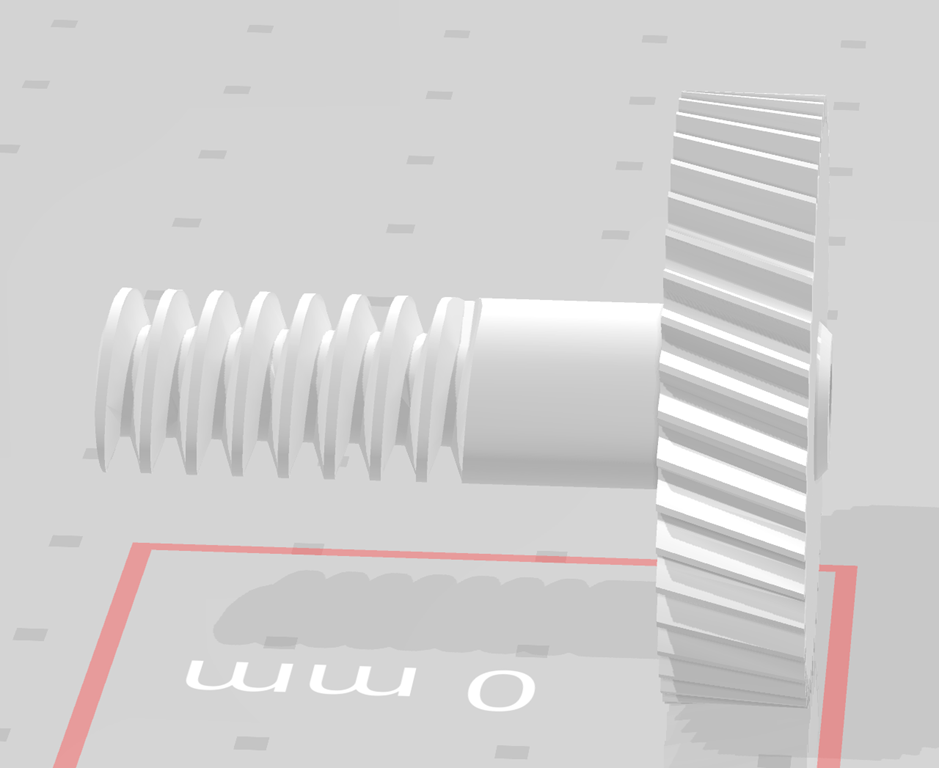
If you look closely at the original cog you see that teeth rise from left to right.

image

but the model I was given (above) has the teeth falling from left to rise. That is, in the opposite direction to the original. This would explain the friction I’m getting when I insert this new wheel.

I got this model from the people I sent it originally to, who failed to produce a suitable result. It now looks like I’ll need to model the whole thing myself from scratch. Painful.

The cog I have printed using the model with the wrong teeth does work but it is a tight and doesn’t move as freely as cog with the correct teeth.

Back to the drawing board.