Hooking new blades

image

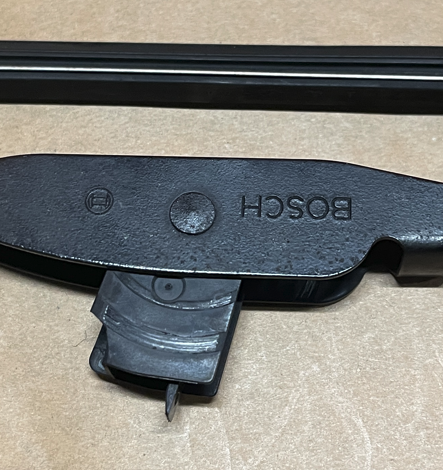
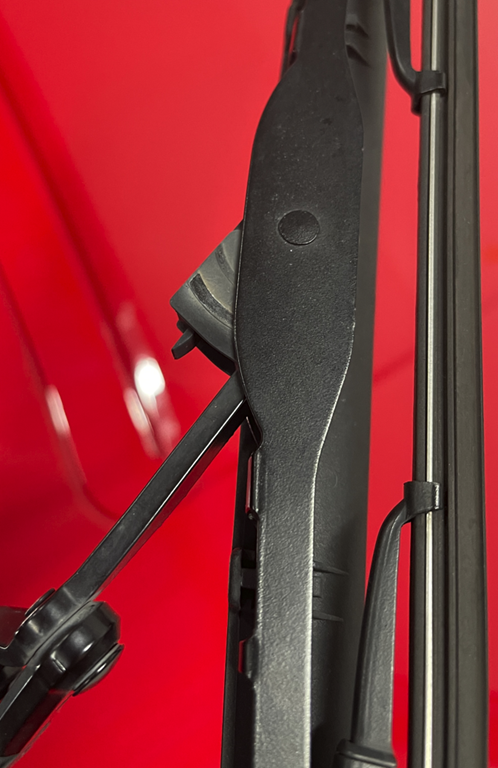
Recently, I started hearing an annoying rubbing sound at the top of my wiper blade travel on the passenger side. Upon closer inspection I found that the blade had detached from the arm as shown above. Thus, when the blade changed direction at the top of its arc, the rubber was dragging on the windscreen.

For replacements, I decided to go with a set of Braumach. These are very different from the existing blades and are basically composed of a long floppy arm that wipes the windscreen. Given that, even when new, the existing blades were not great at keeping the screen clear, I thought I’d give these new ones a go.
image

image

To get the original blades off you’ll find a small lever near the pivot point as shown above. When you push or pinch it towards the blade is probably a better description, you will be able to slide the whole wiper assembly off by moving it towards the windscreen. You may need to slide the water delivery pipe down a little to permit this.

image

Removing the blade assembly will reveal a hook as shown above, onto which the assembly attaches. This is why the blade assembly slides off towards the windscreen initially.

You simply hook the replacement wipers in place on the wiper arm and use their locking mechanism to secure them. Pretty easy. I also noted that the actual rubber on the new blades had a plastic cover which also needs to be removed.

With both wipers back in place with new blades, I took the old blades to the local auto accessories shop and got new rubber blades for that assembly as well. These needs to be fitted and then trimmed to suit. I decided to leave the old blades off but keep them stored, and see how these new ones go. The new ones look more like the wipers on modern cars, such as my daily drive, so I’ll be interested to see how they perform in the wet compared to the original ones.

So a pretty painless process overall and hopefully my blades no longer make an annoying noise at the top of their travel and they provide better visibility.
Solving the ‘chugs’

I’ve been battling a ‘chugging’ issue at warm start up now for almost 12 months, without a great deal of success. The last episode was:

It’s still an issue

After all the engine checks, by two mechanics, i still get the issue. Not all the time, but often enough to be really annoying. Problem is, I can’t replicate it on demand. That makes it extremely tough to troubleshoot.

After the engine check failed to resolve the issue completely, the focus turned to perhaps the problems being related to the third party alarm I have. As I understand things, the 2.7 355’s didn’t come with a factory alarm, while the 5.2’s did.

So I got a clever auto electrician/alarm guy to have a look and he is very confident that it is not the alarm. However, he said that it sounds like the evap system to him!

image

image

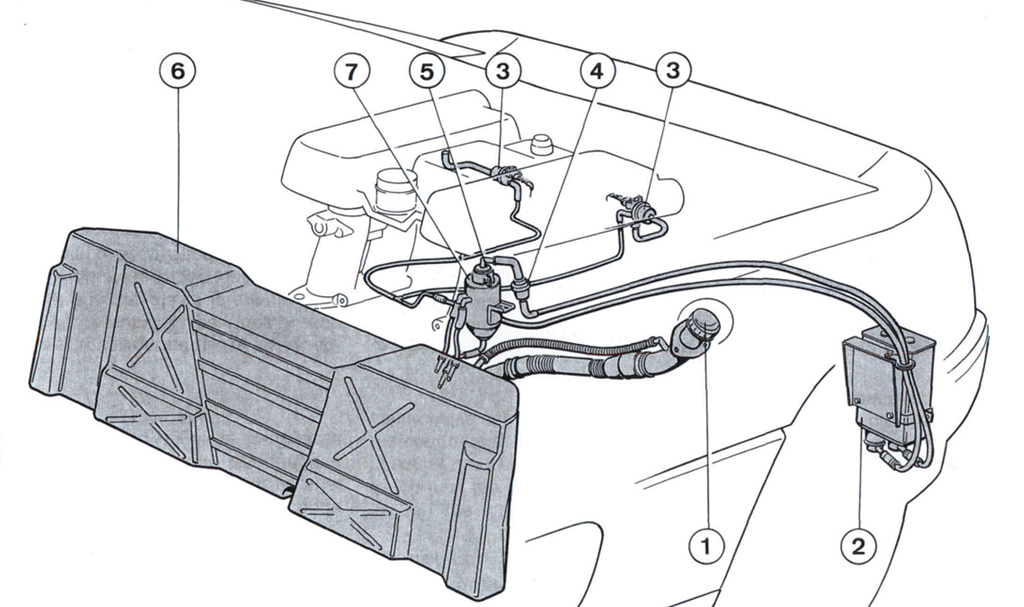
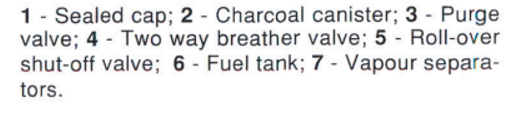
The evap system is designed to capture fuel vapour and store it in a charcoal canister to be burnt off later. As you can see from the above diagram, the system has 2 x solenoids, 2 x valves, hoses and the charcoal canister.

image

image

Looking at my car I see:

image

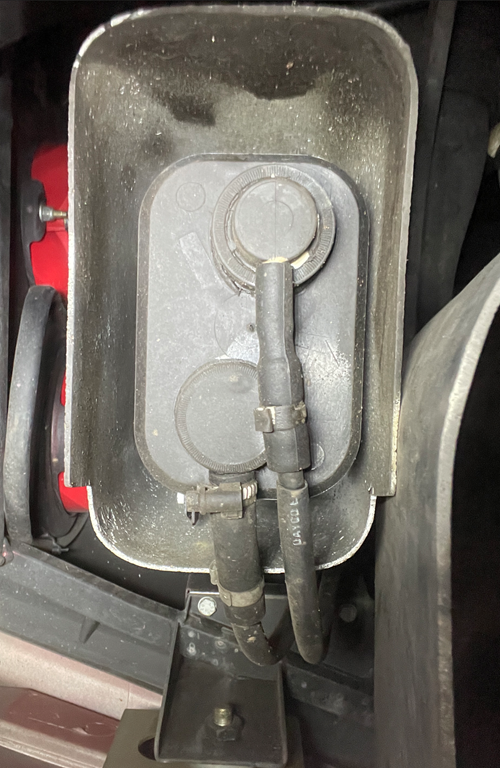
The vapour separator,

image

image

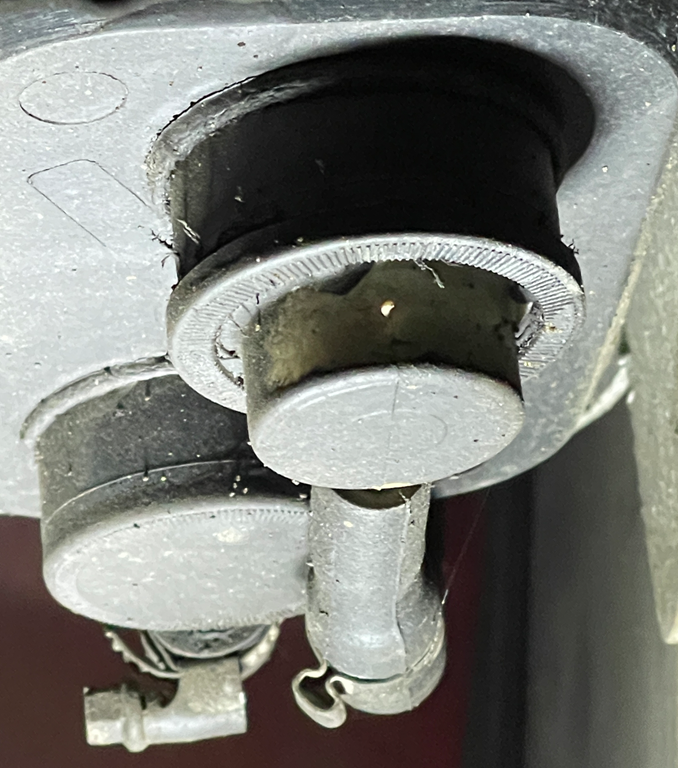
and the bottom of the charcoal canister, which all look good visually. The charcoal canister is housed inside a fibreglass housing.

The suggestion is that if the ‘chugs’ re-appear I should stop the car, take the fuel cap off to let the pressure equalise, restart the car and see if the ‘chugs’ are still evident. If so, that kind of confirms that I have an evap issue.

Typically, the ‘chugs’ only happen after I have been for a long drive, fill the car with fuel and then try and restart it. I’ve had the ‘chugs’ return after paying for fuel and also when I put the car away. The only real commonality is the car needs to be warm for the ‘chugs’ to appear.

Armed with this new method of dealing with the ‘chugs’, of course, nothing happened on my drive and refuel today. However, at least I’m now armed with a simple action that may over come the issue. If that in fact does, then looks like I need to focus my attention on the evap system to find the source of the issue.

Until that happens and I can confirm that it is indeed the evap system causing my issue, I’ll continue to reach troubleshooting techniques. Interestingly, I can’t find a lot about this issue on the Internet. It does seem to be something rare, but then my mother always told me I was special!

Project COG is back in business

Many moons ago a cog in the AC timing actuator failed as I detailed here:

Gear of misfortune

I thought it would be easy enough to get a 3D printed version as a replacement. Oh, how wrong I was. I tried some trusted contacts who were in the 3D printing industry. They referred me onto a number of businesses who unable to print a cog for me.

After more than 2 years trying to get a commercial 3D printing business to print a replacement cog for me, I decided that the only way it was going to happen was if I did it myself. Thus, began another long quest to learn about 3D printing.

A few weeks back my 3D printer selection arrived. After assembling it and doing some test prints, I turned my attention to the real reason for my purchase, to print a simple cog!

Attempt 1

clip_image002

As you can see from the above, this attempt didn’t go well. The issue was the fact that due to the small size of the cog the print lifts from the bed.

Attempt 2

clip_image002[6]

Things are looking better now after some adjustments to the printing process. I can at least see that it is starting to look like a cog, but again the print is detaching from the bed. More adjustments.

Attempt 3

image

YEAH BABY! We have a winner. As you can see the print completed successfully. I needed to some minor clean up on the finished product but I tested it in the Timing Actuator and it seems to work fine.

Oh man, has this been a long (and expensive journey) all to get a replacement for this tiny cog! However, there are a few minor tweaks I need to make to the model so it needs less clean up after printing but I don’t expect that to be too hard. It’ll also be a good way to learn more about the 3D modelling process.

I can now finally say that I have the ability to produce a solution for the 63307100 Timing Actuator gear failing from about two years ago! Even though I do have a number of cogs made by others that work the one I just printed myself now holds pride of place.

During this process, a few readers of this blog contacted me about obtaining a replacement for themselves if I managed to produce them. Well I have and you are welcome to reply to this post, or contact me directly via email and I’ll send you what I have made. Note, that I am still tweaking as we speak and I have not yet actually put the cog into the car so I can’t guarantee that it works on the road, but I’m pretty confident it will. But, if you want to try it and let me know if it indeed does work, contact me a I’ll send you a print.

Hopefully, after a few adjustments I can offer these to people who experience the same issues.


It’s still an issue

pexels-andrea-piacquadio-3777568

So after all the work that was done to try and sort the car, it unfortunately seems to still be there. I took the car on a run over the mountains and pulled over just before ascending for some breakfast. When I tried to start it after a break it took a lot of cranking. Hmmm, this isn’t good I thought! The car finally fired and I started up the mountain.

Unfortunately, about 20 minutes into the drive the car dropped into ‘limp mode’ without and warning or indicators on the dash. I took a side road and pulled over. I tried on/off, to no avail. I tried isolating the battery, to no avail. Thus, my only option was to limp the car home, which is never a fun experience.

As I went to put the car away it almost didn’t start. Crank, crank, crank……finally started but again in limp mode. It had almost no power.

Ok, so off to the shop again. Problem is, Sal from Racing Red was unavailable for a few weeks. Rather than wait and have the car sitting around I decided to try Scuderia Cavallino Servizio instead. Maybe a fresh set of eyes would help?

Sadly, even after being there and having the ignition coils and O2 sensors changed (and of course not displaying any issues), the car still doesn’t feel right to me after taking for a weekend drive. It certainly doesn’t go into limp mode (yet) but there is still an occasional hesitation on crank.

The biggest challenge is the problem is consistent. Typically, the issue manifest itself after the car has been drive for at least one hour. Sometimes, it start fine, with no hesitation. Sometimes, it starts but there is a bit of a ‘glug’ at the end of a long crank and then it fires. Sometime, it takes two cranks to fire. As yet, the car has always started and not failed into limp mode. However, I can still feel the ‘glug’ on occasional start which indicates to me the issue is still there.

So now what? Do I keep driving it in the hope that limp mode doesn’t return? Do I take it back for continued troubleshooting. Decisions, decisions. It is super frustrating that it is a intermittent issues. Makes troubleshooting really tough.

Beyond the 100,000 kilometres barrier

car

Recently, I had the good fortune to attend the Bathurst 12 hour race. This meant a weekend away driving the car in and around the central west of the state.

We departed mid-morning on the Friday and after dropping our stuff off at our accommodation we headed to the Mount Panorama track. Here the ole F355 ticked over 100,000 kilometres total travel distance. Never a more fitting place to do this.

The rest of the weekend was a series of drives to and from the track, as well as around the area. Unfortunately, this did mean exploring some pot holes along the way but hopefully none of them caused any serious damage. It is always annoying to be travelling along at speed and then hit one out of the blue that was hidden or your missed.

Before I left I had the concern of the getting lights and no crank so I had given to Sal from Racing Red to go over. The good news is that he did find a loose connection on the starter motor and since then that particular problem has not re-occurred. The bad news is that that the ‘glugging’ start hasn’t fully gone. I had one instance over the weekend when the car was started and went into limp mode. I turned it off and on again and it was fine.

The issue seems to happen more when the car is warm and stopped for a short while and then started again, like when you stop for fuel. The limp mode incident was only at the end of the weekend, and only the one time. However, the start up is not as crisp as it once was and it feel like a bit of a lottery as to whether it starts fully. So far, the results have been favourable, but there is still an issue I feel. Unfortunately, it is hard to troubleshoot as it doesn’t happen all the time. I’ll need keep track of how it goes, but certainly the no crank issue seems resolved.

Unfortunately, here in Australia, when a car crosses the 100,000 kilometre barrier its value tends to plummet. I have no intention of selling but I kind of wonder what sort of hit the value has taken now?

The trip to Bathurst was a great weekend away with probably almost 700 kilometres of driving in the brilliant sunshine and surrounds. Love that kind of weekend. Let’s see how the start up process gets on from this point and see if there is some way to isolate what the issue maybe.

Onwards to 200,000 kilometres.

New Year, same problems

pexels-andrea-piacquadio-3752834

I hate to say it but my ‘ignition but no crank issues’ haven’t gone away. The car certain starts cleaner after the recent flush, but something still isn’t quite right.

Typically, I have gone for a drive, stopped the car, say to re-fuel, return and I get lights but no crank. I turn the key off and on and car starts.

It worries me that one day I won’t be able to get the car to start all. The most likely candidates for the issue seem to be:

1. Solenoid

2. Ignition relay

3. Alarm

The car does have an after market alarm as factory ones were not available back when the car was made. Perhaps the engine cut out relay in the alarm is failing after all this time? This is hard to troubleshoot without disabling the whole alarm. So my thinking is to get the mechanicals replaced (solenoid and ignition relay) first. Then, if the problem continues, it maybe time to consider getting a new alarm?

The car goes back to Racing Red shortly for a once over again and I’ll report back once that has been completed and if anything was found or replace.

Again, annoying but I need to have it sorted to have piece of mind.


Flushed

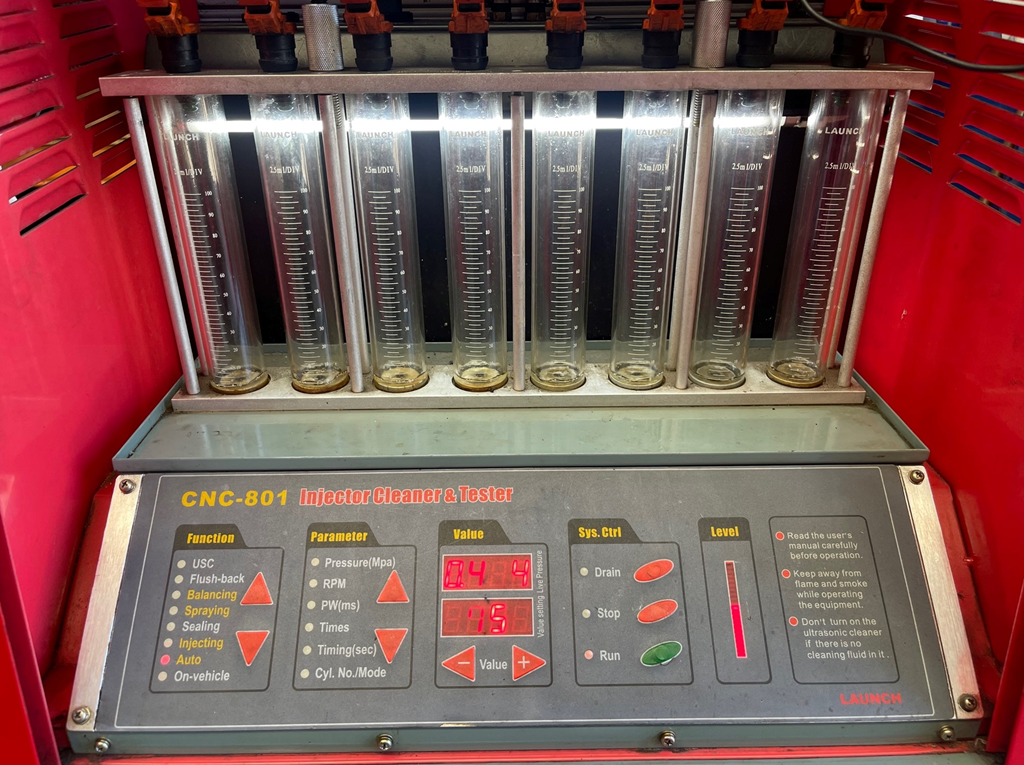
The 355 is back after a visit to Sal at Racing Red to try and solve the ‘spluttering’ problem. He went through the car but the main thing he did was clean the injectors.

image

Using a device that he has, he cleaned and tested all the injectors, which has not been done since I have owned the car.

image

He also went in and change all the spark plugs. My records indicate that these  haven’t been changed in over 8 years, so doing both should make a difference.

While the car was in it had its annual service and rego check, so when I picked it up it was good to go for another 12 months.

On the drive home I did notice a marked difference in performance, which was pleasing. However, while parking the car I did get a ‘lights but no crank’ issue on one restart. I’m kind of wondering whether that has anythign to do maybe with the alarm not fully disengaging? I’ll have to monitor that more closely. However, no ‘spluttering’ was present which is great. Fingers crossed that at least that issue has been resolved and I can enjoy the car over the holidays.

Trouble continues

Unfortunately its appears that the initial attempt at rectifying the ‘spluttering’ problem was unsuccessful. This means an extended stay with Sal to try and get to the bottom of things.

I’ve had to wait a while for Sal to be able to fit me but that will happen next week. Given it is also time for the cars annual service and rego we might be able to squeeze all that in during this visit I hope.

To prepare I took the car out to a local petrol station to get fuelled up and it performed faultlessly. It seems that I only get the ‘spluttering’ once the engine is up to temperature after a long drive. Starting and stopped then seems to cause the issue to arise.

So, it is off for a good check up this week and hopefully a solution to the issue which has been keeping me off the streets of late.

Phase senor replaced

The hunt for the intermittent throttled performance continues. I went out for a drive and all was good. I pulled in to get fuel after the drive and upon re-start the ‘chuggy’ issue returned, with the engine going into limp mode. I stopped and started the car on the spot, but no luck, it stayed in limp mode. Not being far from home, I headed off in limp mode to at least get the car back.

A few hundred metres down the road the fault cleared, and with a bit of a kick I was back to full power. I continued home with no further issues. The good thing was was that any error codes where now captured for analysis.

A few days later, I took the car to Sal so he could read the codes. The engine management was reporting a ‘Stroke error’.

image

image

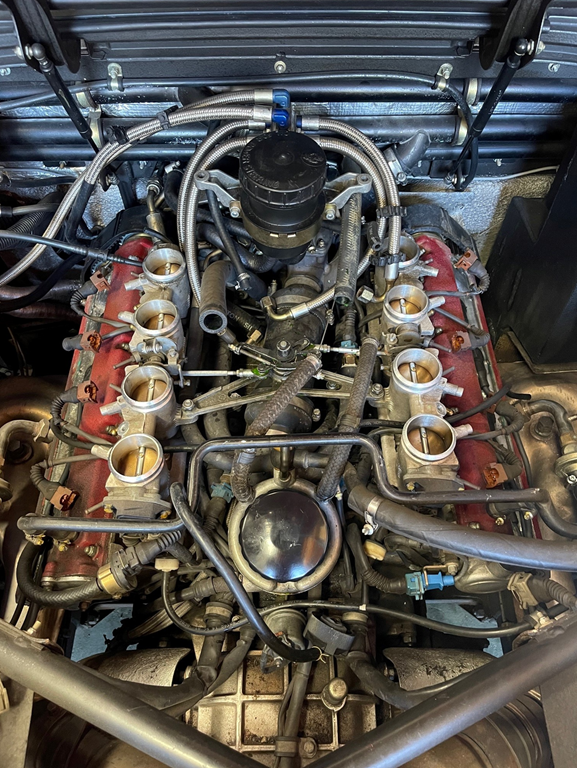
This sensor is on the right hand side of the engine near the cam cover, so it is easy to get to and replace. Cost of a new one was around $400.

The details of the part are:

Bosch 232103006 – Phase Sensor – 3165143101056

Ferrari part number = 150866 – Phase Sensor

I drove the car home again and stopped for fuel. Upon first ignition turn I had no engine crank, just all the dash lights. Oh-no! Off and on allowed me to restart and it’s been all good since then.

Still not 100% sure all the gremlins have been found. Fingers crossed it doesn’t come back!


The reason remain undetermined

pexels-andrea-piacquadio-3831631

After a few weeks delay, Sal from Racing Red was able to come and look at the F355 and guess what? No fault found! Oh man, how annoying.

Maybe, because I had the battery isolated for a long period and the engine fully cooled down, that the problem went away (at least for now).

Given the symptoms, of going into limp mode, one would expect it to be an ECU ‘Slow down’ issue as I have experienced before. But Sal tells me that would generally mean the ‘Slow down’ light would appear on the dash rather than the ‘Check Engine’ light (which is what happened in this case).

If we assume that the ‘Slow down’ ECUs and probes are ok then the issue may lie with the airflow sensor. 

image

The problem with this is that they no longer make this part new. That would mean sourcing a suitable used version. Finding that could prove tough, but let’s cross that bridge when we come to it and know that is actually the problem.

With no fault found all I can do is leave the car turned on and take it for a long drive, stop to get fuel and see if the issue returns. If it does then at least I know I should be able to get it home, isolate the battery again for a period of time, get it working and over to Sal’s workshop so he can take a closer look.

Frustrating that the secret remains hidden as I would prefer not to have the issue arise again when I’m out on a run. Fingers crossed.